Thursday, January 2, 2014

Do Energy Efficient Windows Lower Home Energy Cost?

In order to determine whether a product meets energy efficient standards, there are several ratings used by government agencies and window experts. Essentially the most well-known, Strength Superstar ranked merchandise is qualified by way of a set of specifications established through the U.S. Division of Strength along with the USA Enviromentally friendly Security Organization. One measure may be the U-aspect, which reveals the speed in which a window guards against warmth decrease. Another similar rating is the solar heat gain coefficient, or SHGC. This actions the window's opportunity to deflect the sun's heat. Jointly, these defense variables work to maintain the ambiance within during the the winter season as well as retain the heating in the sunshine out during the summer months. The Look Strain Standing, or DP, procedures the pressure a closed down, shut home window has the capacity to stand up to below force. A top DP rating will signify that any windowpane can more effective withstand the causes of nature or even a break in endeavor.

Adding vitality-efficient and insulated glass in your own home will lessen your electricity monthly bill tremendously. It will help you defend your floors, paintings and furniture along with other beneficial goods in your own home. Cost effective glass windows will not be created equal. Every windowpane kind provides a distinctstyle and price, and function. You should thoroughly review your options so you can buy in confidence, before you purchase and install windows on your home.
Very low-E cup is a type of kind of electricity-productive home window that an individual might uncover in every household-development retailer. The "E" in Very low-E refers to emissivity which means the amount of heat the glass radiates. Low-E means low glowing energy, that suggests the glass will reveal much more heat that it will absorb.

Folks drive minimal-e glass with their properties because of its ability to insulate very well. It can do a very good employment of reflecting the sun's warmth through the summer season and preserving the frosty air flow out through the winter months. Very low-E window is normally twice-pane window that is definitely a bit colored. The room between your cup is packed with a gas, for instance argon, which serves as a possible insulator.

Glass
home windows covered with solar power panels or windowpane tint are energy-productive too. Companies position the tint in the interior window to help keep it from cracking or damaging. It really is common to locate tint on one-pane windows simply because single-pane home windows have great emissive characteristics. Placing tint on a high emissive window minimizes the level of sun light that enters in to the house. Additionally, it stops the staining ofdrapes and furniture, and wooden ground solar panels.

Thunderstorm glass windows and direct cup house windows are effective insulators also. Thunderstorm glass windows maintain extreme noise and wind out of your home even though steer glass glass windows retain higher levels of sunlight and heat out. Lead cup home windows are available in decorative designs but many of them are opaque or semi-apparent. Surprise windows are translucent nonetheless they give minimal defense towards furniture and floor slight discoloration. Someone that wants storm windows can also add a coating of solar energy movie for the window for sunlight security. An individual who wants guide glass can purchase triple-pane guide cup windows for maximum proficiency.

Wednesday, November 13, 2013

Energy Loss Through Crawl Spaces

A Fort Collins home energy audit isn't complete with no trip underneath the floor. You will find home energy secrets underneath the floor just waiting to become discovered - things that should be considered before a real determination can be created regarding energy waste and savings.

Entering a crawl space is much like entering a contaminated cavity of unknown challenges. This jogs my memory of 1 reason I'm not a dental professional. A real Fort Collins insulation company suits track of protective clothes, mask, mitts, hat, and shoes. The smart leave their glasses, mobile phones, apple ipods, cameras, along with other belongings behind least you won't ever discover their whereabouts again. Lost at nighttime and moist where batteries melt and electronic devices turn rust colored.

The area underneath the floor is extremely unfriendly except to individuals animals which have four legs rather than two. There is not a pet roaming the area that will not enjoy being beneath your ft on the cold winters evening. Burrowing in to the insulation or trying to catch up with to some warm heating duct, the creature isn't worried about shredded insulation, holes in heating ductwork, wasted energy, or perhaps your exhausted pocketbook.

A crawl space is a superb club house - a location to obtain warm, hideout, meet your buddies and use the bathroom.

Creatures get access to the crawl space through guy made openings:
  1. The outdoors foundation access having a door that merely doesn't close completely and
  2. The building blocks vents which have lost their plastic flappers and also have large holes within the fine wire mesh.

The wire mesh is built to let air go through therefore the space can breath. It is important the space has enough ventilation. With damaged or missing screens, besides air go through the vent, but every person in the feral community does too. Creatures within the crawl space is energy inefficient. And, simply to be useful, individuals same creatures, whenever you go into the crawl space to correct the harm, leave little aromatic memory joggers of the have to get rid of the outcomes of a digested mouse or two.

The healthy, energy-efficient crawl space has only five things inside it.
  • Cold and hot water lines.
  • Drainpipes for that waste water.
  • Heating ductwork
  • Insulation
  • And black visqueen since the ground.

Monday, November 11, 2013

REenergize has expanded their Services to Loveland

REenergize CO, a company from Denver Colorado has expanded their energy audit and insulation services to Loveland, Colorado.  The Colorado company has been offering their home efficiency testing since 2006 to homes and small business in the Denver metro.

Now that REenergize CO has expanded its services to these two great communities, home owners can get the following great services at affordable prices:

Attic Insulation
Attic insulation keeps your home warm in winter and cool in the summer. As heat rises in your home it naturally moves to cooler areas and places where temperature differences are measurable. By insulating your attic spaces you provide resistance to heat flow ensuring that heated or cooled air remains in the interior and isn't escaping through your ceiling and roof. Inadequate insulation, gaps and leaks in your home will cause your heating and cooling system to run longer and more often in order to maintain temperature in your home. As a result, your furnace or air conditioner will consume more energy which results in higher energy bills. Proper Attic insulation saves you money year after year; over time helping to pay for itself in lower heating and cooling costs. 

Ductwork Sealing
Home improvement experts use the patented Aeroseal sealing process which is the most effective, affordable, and viable method of sealing central heating & cooling and ventilation ductwork in residential homes. This process is clean, safe, and guaranteed for 10 years.  Aeroseal Duct Sealing technology is a patented breakthrough that fixes leaks in your ductwork from the inside out. The correction process causes polymer particles to stick to the edges of a leak and then stick to each other until the leak is closed.

Friday, August 9, 2013

Energy Star Certified Lighting

Most Energy Star-qualified fixtures come with pin-based CFLs, which makes it more difficult for people to swap them out of less energy efficient incandescent bulbs after initial use. However, not that some Energy Star outdoor fixtures will accept an incandescent bulb because they save energy through a  motion sensor and or photocell.

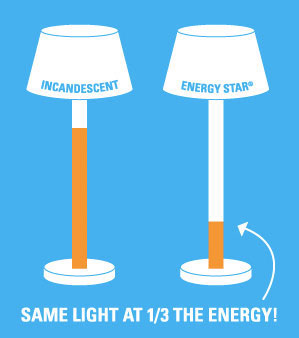
Energy Star-qualified fixtures are readily available in the marketplace and come in hundreds of popular styles, including floor, table and desk lamps as well as in a hard wired style for typical ceiling, wall, bathroom or outdoor light fixture. Many of these light fixtures and bulbs support an automatic daylight sensor, dimming switch or motion sensor.  According to Energy Star, if every home in the US replaced the five light fixtures it uses most with registered models, it would prevent greenhouse gases equivalent to the emissions of nearly 10 million vehicles.  That is an impressive number!

An Energy Star Qualified light fixture has the following characteristics:
  • They use one-quarter the energy of traditional lighting fixtures
  • They must distribute light more efficiently and evenly that other standard fixtures
  • They support bulbs that must last at least 10,000 hours. (Typical light bulbs like incandescents last 1,000 hours)
  • They carry two-year warranty which is double the industry standard

Thursday, July 11, 2013

Aspects of a Full Home Energy Audit

Many homeowners are looking for ways to make their home more energy efficient and save money on their utility bills. Often times the energy company that performs a free home energy audit only checks obvious areas like lighting and air sealing.
It is important that your home energy auditor performs a complete home energy audit. Vital aspects of your home that should be checked in a home energy audit include:


*Heating and cooling system: Learning about the energy efficiency of your heating and cooling system is essential. If this is not checked there could be an abundant amount of energy being lost that you do not even recognize. Heating and cooling accounts for a large amount of energy use in your home and can be a major source of energy loss as well. Getting a complete home energy audit that assesses your heating and cooling system is something that you don't want to go without.
* Sealing: Although air sealing throughout your home is an obvious check, make sure it fully evaluates the air sealing. Simply checking around windows is not enough for your energy audit. A proper one should check for air leakage in your attic, foundation, and around any vents that may be letting in unwanted air.
When places are found throughout your home that are not sealed properly, it should suggest fixes such as insulation in the attic or basement, caulk and weatherstripping around doors and windows, and foam gaskets behind outlet and switch plates on walls. These fixes will keep in the conditioned air so that you are not wasting energy heating or cooling the outside, unconditioned air.
* Insulation: They are only complete when the insulation in your home is fully assessed. Many homeowners believe they have enough insulation in their home when this may actually be a major cause of energy loss. Simply checking to see if there is enough insulation is not a complete energy audit either though. Assessing your insulation r-value is essential.

Read more here

Wednesday, July 10, 2013

How to Measure the R-value of Attic Insulation [VIDEO]

Here is a video from REenergizeCO in Denver, Colorado.  They talk about measuring R-value in insulation and the correct amount needed in an attic of a residential home.  Nearly 50% of homes in the US do not have an adequate amount of insulation in their attic and suffer with higher utility bills.  This video shows you how to detect if your home has enough attic insulation.
 

Tuesday, July 9, 2013

7 Steps to Energy Savings

If you are afraid to open your gas or electric bill each month, reducing your home's energy use should be a priority of yours. Energy efficiency and pleasant indoor environment work hand in hand.  In this article you will learn how to evaluate your home's energy performance, determine where the biggest savings lie and maintain a healthy indoor environment.  You can find your home more comfortable and reduce your utility bills by following these 7 simple steps:
  1. Hire an Energy Auditor
    When it comes to saving energy, it is worth hiring a pro to evaluate your home and help you sort out the many possible energy-savings strategies.  If you are not sure how to find an energy audit company in your area, contact the local utility company to find energy auditors. It may supply this service for free or recommend an auditor.
    An energy audit typically costs between $250-450 and can be subsidized through a tax credit or community program.  The energy auditor will inspect your home and rate its current performance in terms of insulation levels, air leakage, condition of heating and air conditioning equipment and some other criteria.  The auditor can then tell you which upgrades are cost effective and estimate your energy savings. Cost-effectiveness is the absolute key! You can spend thousands of dollars for upgrades that won't save you much and a good auditor will steer you away from those. For an improvement to be worthwhile, the estimate savings should cover the cost of the improvement in about seven years.  An example being adding $200 in attic insulation will be worth it if you can save $30 a year ($210 after seven years).  Make sure the audit includes estimated savings for any improvements.
  2. Reduce Air Leakage
    Think of the warm air leaking out through gaps, cracks and holes in your home's walls and ceilings as your energy dollars floating away.  Sealing these openings is one of the greatest ways to save energy and is actually the most cost effective too.  Stopping air leaks in your attic is usually enough. You don't have to work your way through every room caulking every crack inside and out - you just need to cover the largest.
  3. Conserve Energy
    There are hundreds of energy savings steps that cost little to no money. Some ideas involve small investment of time and money like a programmable thermostat or caulking around windows, lowering the temperature on your water heater and closing your curtains.

Tuesday, June 25, 2013

20 Tips to Save Energy Around the Home

The best part about this list is all of these tips are FREE!  They won't cost you a dime and actually help you save energy and lower your utility bills for your home.
  1. Close the fireplace damper when you are not using your fireplace.  If it is never used, seal the flue with a plastic bag stuffed with insulation.
  2. Lower the indoor temperature a few degrees in the winter months.  You can add an extra blanket on your bed and lower it even more at night, up to 10 degrees when you're on vacation.
  3. Close off unused rooms and lower the temperatures by adjusting your registers and dampers. This can save you up to $50 a year alone.
  4. Open your shades or blinds to let in sunlight during the day and close them at night to reduce heat loss. For cooling, close them fully during the day in summer months.
  5. Clean your furnace's blower fan with a soft brush and vacuum cleaner.
  6. Ventilate and cool your home with window or whole house fans during the cooler hours of the day.
  7. Skip the dishwasher's drying cycle to cut energy use in half!
  8. Wash clothes in cold water rather than warm.
  9. Make sure to full fill washing machines and dishwashers for more efficiency use instead of partially full loads.
  10. Turn off lights that are not in use. Reduce bulb wattage and use dimmer switches.
  11. Clean you washer and dryer filters after each use.
  12. Flush your garbage disposer with cold water rather than hot. Grease solidifies in cold water and will wash away.
  13. Clean your refrigerator coils with a soft brush each spring.
  14. Run major appliances late in the evening or early morning to keep temperatures down in summer months and avoid heavy electric loads.
  15. Cook more efficientyly using microwaves, crockpots and pressure cookers.
  16. Ride your bike for neighborhood errands instead of your car.
  17. Turn off room air conditioners when you leave for an hour or more.  A room can quickly cool down when you turn your AC unit back on.
  18. Reduce humidity in bathrooms and kitchens wih exhaust fans. When dehumidifying your basement, close doors and windows.
  19. Lower your water heater setting to 120 degrees for energy savings.
  20. In warmer weather, set the thermostat higher, 74-76 degrees, and rely on your ceiling fans for cooling even when your air conditioning system is on.
Here are some helpful videos about home insulation.  Another great way to save money on your energy bills:
  1. Attic Insulation
  2. Crawl Space Insulation
  3. Home Energy Audit

Thursday, May 2, 2013

Using Blown-In Insulation

If you need to create warmth inside your attic, save big by blowing inside insulation warmth oneself. The good qualities cost $1, 500 in order to $2, 000 to complete the 1, 200-sq. -ft. household. You can apply that oneself for approximately $500. Spitting out attic warmth isn’t tough, nevertheless it’s messy, exhausted operate. To create that less complicated, get the tool in addition to reserve a couple days: just one with regard to attic preparation plus the minute to truly knock back your warmth. From the stop on the weekend break you’re going to possibly be uncomfortable in addition to worn out. But keeping $1, 000 or higher may make up for your tender back.

This long-term benefit is outstanding as well. You can observe your efforts bills drop by approximately 15 in order to 25 % based on your weather in addition to active amounts of warmth. And you will in addition be entitled to the tax credit ratings about the expense of your warmth.

To demonstrate you tips on how to get the job done right, most of us questioned your skilled to express their methods for creating the project proceed effortlessly in addition to enable you to prevent the top several attic-insulation mistakes.

Seal leaks

Yank back the existing warmth in addition to utilize increasing bottle of spray froth in order to close any kind of breaks all-around plumbing water lines, ceiling perforations in addition to slots where by electric powered wire connections snake by means of. “Make confident in order to close all the way up about the water pipe, ” says Olson. Pertaining to breaks 1/4 inside. as well as a smaller amount, utilize caulk rather than increasing froth.

Add ventilation

Yank the existing warmth from your roof. Placement the newest in-take chute therefore the bottom part expands 6 inside. to the overhang in addition to staple that in location. Olson recommends using a contract stapler instead of the retracted stapler. “It’s additional precise in addition to there’s a smaller amount chance you’ll crumple your chute. ”

“In 95 pct on the households most of us work with, your in-take chutes usually are missing out on as well as aren’t correctly set up, ” says Olson. With out these, you’re not having the almost all through your insulation’s R-value since oxygen would need to move correctly on the eaves to eliminate wetness within the wintertime in addition to temperature within the summer time.

To ensure active chutes aren’t impeded, stand within a darker attic to see whether light on the eaves is selection throughout the vents. Exchange any kind of chutes which might be impeded, ruined as well as missing out on. You’ll uncover equally plastic-type material in addition to froth in-take chutes in the home facilities. Olson advises employing froth chutes. “They’re additional strict in addition to there’s a smaller amount prospects for these having crumpled as well as squeezed any time you’re putting in these.” Yank back the existing warmth to help you to observe out there to the border on the eaves, in addition to purchase a in-take chute in each and every rafter room.

Insulate access ways

Cover your attic hatch that has a cushion regarding fiberglass warmth. “You want a pleasant, big puffy cushion regarding warmth to avoid any kind of oxygen water leaks, ” says Olson. Slice a couple levels regarding R-19 fiberglass batt insulation slightly larger than your hatch in addition to staple duct recording to the hatch sides in order to safe that set up.

To hold your warmth by decreasing throughout the attic hatch launching, complete a 2x12 dam about the hatch border. “Then, to actually close your attic entry way up snug, ” says Olson, “lay fiberglass batt warmth on the inside of your hatch as well as door in addition to put that way up snug being a Holiday present." You'll be able to insulate your hatch door even though you’re into the attic as well as go the entrance way out there in addition to do it additional easily with a tarp outdoors.

Mark reference points

Compare well on the drywall in order to tag your sought after warmth level. Start using a long term gun in order to tag the particular level each and every number of trusses and that means you know you've even insurance about the entire room.

When you're blowing warmth, it could find messy in addition to tough to see whether you have got that serious ample about the entire attic. Mark the desired level about diverse roof trusses about the attic when you star.

Friday, April 5, 2013

INSULATING YOUR HOME WITH A PREMIUM EXTERIOR PAINT JOB

Save energy costs and insulate the outside of your home with meticulous practices. Insulate the outside of your home with a NASA-inspired insulating paint product.

• Techniques to Save Energy Costs While Painting Your Home

Windows and doors and clothes dryer vents are where most conditioned air escapes and unwanted exterior air sneaks in, costing the homeowner money in his or her energy bills. A quality exterior painter knows this, and will seal gaps not just for aesthetics but to save you money.

First and foremost: siliconized caulk. Gaps around windows and doors need to be caulked before they are painted. Make sure the surface is clean and free of dust and grease, then apply a bead of caulk and smooth it with your finger so it fills the gap. This will help make the doors and windows airtight. This can save you up to $100 per year.

Secondly, when painting window sashes and their glazing it is a good idea to leave a line of paint over the glazing and on the glass that is roughly 1/10th of an inch wide – this well help create an airtight barrier on the glass pane and the glazing, preventing any drafts from entering the home.

Also, make sure to repair or replace rotted wood trim and siding. If not, moisture and air can find its way inside and adversely affect your energy bills, while compromising the structural integrity of your home.

Remember:
The exterior paint on your home is the skin that protects its structural elements from the weather, so a high-quality, professional paint job is important to your home’s longevity.

  • Insulating Paint inspired by NASA: The Next Big Thing?

Insulating paint, or radiant barrier paint, is a relatively new product that is still under scrutiny. This type of paint essentially uses traditional paint with an additive that’s main purpose is to reduce the build-up of heat, thereby insulating the building from the outside. A similar type of coating is already used today on piping and ductwork.

Wednesday, April 3, 2013

DIY Home Energy Audit Checklist

Home energy audits are the best way to start saving on your energy bills. Although performing a home energy audit on your own may not get you the same results as a professional home energy audit, it will still help pinpoint improvements that need to be made. DIY home energy audits are
simple procedures that do not require buying any equipment. Arm yourself with an energy audit checklist filled with simple questions that will help you through the process of finding areas that need improvements. By performing an energy audit you'll identify problems with your home and some habits you and your family will need to break. This energy audit check list has six areas of evaluation.

  1. Air leaks: Check areas like windows, doors, electric outlets, fans, light switches, the basement, the attic, fireplace and air-conditioners. Air leaks seriously raise the cost of heating and cooling bills and it is essential to make sure these areas are properly sealed. 
  2. Insulation: Proper insulation will help you save on heating and cooling bills. Check to make sure your insulation levels are up to code so you can be sure your home is not leaking expensive hot and cold air. You'll want to check the attic, basement and accessible walls and floors to see if they are insulated properly. If you can't access these areas call a professional home energy audit company, or Denver insulation companies because they will have to tools to access the insulation levels without causing damage to your home. 
  3. Heating Systems: An efficient heating system and hot water heater will save you up to 40 percent on your energy costs. If your furnace is old, replace it with a newer more efficient model (after properly insulation your home and inspecting the ductwork). Tankless water heaters will are a great way to save money on heating water.

Monday, April 1, 2013

Residential Denver Energy Challenge


For residents of Denver seeking to lower their environmental impact and energy bills, the Denver Energy Challenge offers resources that help. Denver received a $25 million grant from the Department of Energy's Better Buildings Program to improve efficiency of the City and County. The Challenge is designed to increase efficiency investments, advance energy independence and help stimulate economic growth. The Denver Energy Challenge has a goal to improve 6,000 homes and 1,200 businesses by May of 2013. Other goals are to reduce usage by 15 percent (or more), reduce utility bills for residence and to create jobs in the energy efficiency industry.

The Denver Energy Challenge recommends qualified contractors to homeowners looking to join in on the challenge. In order to be able to receive funds from the Challenge, homeowners must use a contractor, or contractors, that have been approved. The qualified contractors are involved in several fields including Insulation and Air sealing, Mechanical/ HVAC, Solar and Windows. Hiring Denver insulation companies is a wonderful way to save a significant amount of money on your home energy bills. Professionals in these industries are well equipped to help reduce waste and overspending.

Thursday, March 28, 2013

Home Fan Installation Tips

Posted by: Jeffrey Ahbe

Most fans used in heating, ventilating and air conditioning installations are powered by electric motors. Because of the small sizes of most home fans, the majority are equipped with direct-connected motors. A V-belt drive arrangement is used with larger fans, particularly centrifugal fans used in forced warm-air furnaces or the larger ventilating units found in commercial and industrial installations.

The following are tips and recommendations for proper fan installation in your home.  Home fans help circulate and vent the air in your house.
  1. When possible, install an exhaust fan or air outlet on the leeward side so that the air leaves with the prevailing winds.
  2. Install the fan and air intake openings at opposite ends of the enclosure so that the intake air passes lengthwise through the area being ventilated.
  3. Provide a net intake area at least 30 percent greater than the exhaust fan opening.
  4. When possible, install ventilation (supply) fans or air intakes on he windward side so that the entering air utilizes pressure produced by prevailing winds.
  5. When a filter is used, increase the net intake area to allow minimum pressure loss from the resistance of the filter.
  6. An explosion-proof motor with a spark-proof fan should be used when the exhaust air is hazardous.
  7. Steam, heat or odors should be exhausted by fans using totally enclosed motors mounted near the ceiling. The air intakes should be located near the floor.
  8. Spring-mount fans and connect them to the wall opening by a canvas boot when extremely quiet operation is required.
If you are unsure if your home is ventilated properly, you can have a blower door test completed that tests the air flow of your home.  This is also a great way to find out if your home has other air leaks outside of your hvac system.  Here is a great video showing the Home blower door test at work!

If you are interested in a home energy audit, contact REenergizeCO (720) 530-5259 for a free in home estimate.

Wednesday, March 13, 2013

Combustion Appliance Zone Testing

Combustion Appliance Zone testing, or CAZ testing, is an important piece of a complete Home Energy Audit. Denver Energy Audit specialists performing a complete Home Energy Audit will perform CAZ testing on your appliances. CAZ testing is important because the health and safety of your family depends on these appliances working properly. Carbon monoxide is a poisonous gas that can kill people and other animals. Infants and the elderly are most susceptible to CO poisoning however it can also affect a healthy individual. In the United States, there are over 400 deaths per year attributed to CO poisoning. Tests of appliances in the combustion zone check to see that there is no leakage of flammable fuel or gases into the living space. CAZ testing should be performed before and after weatherizing a home.

There can be many problems with appliances in existing homes, especially older homes. Older homes typically have older combustible appliances and ventilation systems that may not be up to the current standards for safety and performance. Appliances that most typically cause CO leaks are fuel-burning furnaces, boilers, and water heaters, space heaters, fireplaces and gas ranges and ovens. All of these appliances must be tested during CAZ testing.

Tuesday, March 12, 2013

Tips on Attic Insulation

Adequate insulation and air sealing of your attic will help lower energy bills for homeowners. Attics are the most cost effective place in the home to insulate. Insulating an attic will immediately raise the comfort level of your home and reduce energy consumption. Attic insulation helps keep your home warmer in the winter and cooler in the summer.

insulationNo matter what type of insulation you currently have in your attic, the quickest way to determine if you need more is to use a tape measure. Start by surveying your attic, if the insulation level is level with or below your floor joists you'll need to add more insulation. If you cannot see the floor joists and can stand on them while the insulation reaches past your knees the insulation levels are most likely sufficient. Insulation should be evenly distributed with now parts of the ceiling showing. Sometimes contractors will move insulation to make improvements and repairs, if they don't replace the insulation when they are finished your insulation will become ineffective.

Monday, March 11, 2013

Save With An Home Energy Audit

By
Who needs a home energy audit? The energy efficiency of a home in terms of heating and cooling can be determined with an energy audit and suggestions can then be made to save on electricity. Saving energy and money by quantifying the buildings thermal performance is the goal. A written report based on the orientation towards the sun, climate conditions and thermostat settings may be part the audit.

An energy audit will point out the areas where the most energy is wasted and being aware of it will enable you to employ some measurements on the suggested areas. This will save you the trouble of insulation the whole building. For instance insulating your geyser with an insulation blanket purchased at the local hardware store can on its own make a huge difference in that local area.
Excessive energy loss true the ceiling can be picked up with an energy audit. Putting your own insulation in on the ceiling is not as hard as it may sound and it will be a very rewarding DIY project. You will also be able to do it for a a lot less than a contractor will charge you.
The air leaks in the window seals and doors are one more area where one can make a big difference. Fixing that up is not difficult but it can save you a lot of energy and money in heating up a house in winter.

Friday, March 8, 2013

Energy Efficiency in Homes

 Building energy efficient homes and improving energy efficiency in our homes can increase their value.
Over the past few years, there has been a ground swell of Green building interest by home buyers and builders. In response to the growing demand to conserve energy in our homes, there are several new mortgage programs that allow home buyers to finance the cost of energy improvements into their mortgage, to increase their loan-to-value, or improve their qualifying ratios. Some of the more common improvements that are used to make homes more energy efficient include the addition of new windows, high efficiency heating/cooling systems, and improved insulation. All of these contribute to reduced energy use, and also to making homes quieter, more comfortable, and more desirable. 
Mortgage Programs 
These programs allow buyers to purchase a more expensive home that has a lower cost of ownership to offset the larger mortgage payment. There are 2 types of financing options available that cover a variety of scenarios for energy efficient homes.
o Energy Efficient Mortgages (EEM's) allow borrowers to qualify for a larger loan, using expanded income ratios, sometimes with the same down payment.
o Energy Improvement Mortgages (EIM's) allow borrowers to include in the mortgage the cost of making an existing home more energy efficient, when they refinance or purchase the home. 
These products are available through your local mortgage brokers and banks using FNMA, FHLMC, FHA, and VA guidelines.

Wednesday, February 27, 2013

Why You Should Enclose Your Home's Crawl Space

Most homes have either a crawl space or a basement. Crawlspaces have several advantages to basements. Crawlspaces elevate the home above the ground and are much less expensive than a basement. Crawlspaces also make space for duct work and plumbing to run and are easily accessible for contractors. Crawlspaces are great however, without taking proper precautions they can breed mold and mildew and allow moisture to compromise the structure of your home. Insulating a crawl space is in your best interest for many reasons. Here I have outlined the top reasons to insulate and seal your home's crawlspace.

Monday, February 25, 2013

Installing Plastic Window Insulation

Not all home improvement projects will break the bank. Insulation Denver CO home owners will tell you, is important to the comfort of your home. Window insulation is easy, very cheap and effective. Window insulation film is carried in most hardware stores and fits almost any window. This product is a heat-shrink film that is stretched over the interior side on a window frame to block drafts.

If you decide to insulate your windows using plastic film, you'll need to choose which window to use this method on carefully. The windows you seal using this method cannot be opened after the film is applied. If you only have one window in your kitchen, you should not insulate it with film in case it needs to be opened due to a small kitchen fire, or burnt food. Also, if you don't plan on removing the Denver insulation after winter, it is important to keep windows on opposite sides of your home uninsulated so that you can open them to enable a cross breeze during nice weather.

After deciding on which windows you'll insulate, you need to gather supplies. For this project you need a window film kit (or more if you wish to insulate multiple windows), tape measure, scissors and a blow dryer.

Step One: Prepare the Window
Clean the window frame with soapy water and then wipe it dry. Allow for additional drying time, if needed. After the window has dried enough, apply the adhesive tape included in the window insulation kit.

Thursday, February 21, 2013

Insulating Tips for a Shed

ByDoItYourself Staff

Insulating a shed may seem silly at first but your shed has many uses and adding insulation can further increase its usefulness. In essence, the shed on your property is an extension of your home. For many people it is used as seasonal storage and for others it can become a home away from home. Sheds are often used as workshops from wood working to motorcycle maintenance. Some are being converted to small recreational spots where couches, chairs, televisions and small appliances are being placed and used. The following article will help provide you with some useful hints and tips on how you could insulate your shed.

Siding and Air

One type of insulation is commonly known as an air barrier. These are sheets of treated plastic commonly found on the outside of a new home. This does not mean you cannot use it on your shed. The air barrier material helps keep air outside where it belongs and this keeps the internal temperatures at bay. The air barrier is wrapped around the shed and tacked in place. On top of the air barrier you would then place some sort of siding. The kind you use on the shed is irrelevant and can be plastic, wood or aluminum. The combination of the two keeps drafts out of the shed to create a more stable internal climate.

Using the Pink Stuff

Fiberglass is the most commonly used insulation material you can find. You install it in the inside of the building between the studs. You then have to cover the fiberglass with more wall material. Fiberglass is a good vapor barrier and will protect against humidity which can cause your wood in the shed to warp and potentially rot.