Wednesday, November 13, 2013

Energy Loss Through Crawl Spaces

A Fort Collins home energy audit isn't complete with no trip underneath the floor. You will find home energy secrets underneath the floor just waiting to become discovered - things that should be considered before a real determination can be created regarding energy waste and savings.

Entering a crawl space is much like entering a contaminated cavity of unknown challenges. This jogs my memory of 1 reason I'm not a dental professional. A real Fort Collins insulation company suits track of protective clothes, mask, mitts, hat, and shoes. The smart leave their glasses, mobile phones, apple ipods, cameras, along with other belongings behind least you won't ever discover their whereabouts again. Lost at nighttime and moist where batteries melt and electronic devices turn rust colored.

The area underneath the floor is extremely unfriendly except to individuals animals which have four legs rather than two. There is not a pet roaming the area that will not enjoy being beneath your ft on the cold winters evening. Burrowing in to the insulation or trying to catch up with to some warm heating duct, the creature isn't worried about shredded insulation, holes in heating ductwork, wasted energy, or perhaps your exhausted pocketbook.

A crawl space is a superb club house - a location to obtain warm, hideout, meet your buddies and use the bathroom.

Creatures get access to the crawl space through guy made openings:
  1. The outdoors foundation access having a door that merely doesn't close completely and
  2. The building blocks vents which have lost their plastic flappers and also have large holes within the fine wire mesh.

The wire mesh is built to let air go through therefore the space can breath. It is important the space has enough ventilation. With damaged or missing screens, besides air go through the vent, but every person in the feral community does too. Creatures within the crawl space is energy inefficient. And, simply to be useful, individuals same creatures, whenever you go into the crawl space to correct the harm, leave little aromatic memory joggers of the have to get rid of the outcomes of a digested mouse or two.

The healthy, energy-efficient crawl space has only five things inside it.
  • Cold and hot water lines.
  • Drainpipes for that waste water.
  • Heating ductwork
  • Insulation
  • And black visqueen since the ground.
Monday, November 11, 2013

REenergize has expanded their Services to Loveland

REenergize CO, a company from Denver Colorado has expanded their energy audit and insulation services to Loveland, Colorado.  The Colorado company has been offering their home efficiency testing since 2006 to homes and small business in the Denver metro.

Now that REenergize CO has expanded its services to these two great communities, home owners can get the following great services at affordable prices:

Attic Insulation
Attic insulation keeps your home warm in winter and cool in the summer. As heat rises in your home it naturally moves to cooler areas and places where temperature differences are measurable. By insulating your attic spaces you provide resistance to heat flow ensuring that heated or cooled air remains in the interior and isn't escaping through your ceiling and roof. Inadequate insulation, gaps and leaks in your home will cause your heating and cooling system to run longer and more often in order to maintain temperature in your home. As a result, your furnace or air conditioner will consume more energy which results in higher energy bills. Proper Attic insulation saves you money year after year; over time helping to pay for itself in lower heating and cooling costs. 

Ductwork Sealing
Home improvement experts use the patented Aeroseal sealing process which is the most effective, affordable, and viable method of sealing central heating & cooling and ventilation ductwork in residential homes. This process is clean, safe, and guaranteed for 10 years.  Aeroseal Duct Sealing technology is a patented breakthrough that fixes leaks in your ductwork from the inside out. The correction process causes polymer particles to stick to the edges of a leak and then stick to each other until the leak is closed.

Friday, August 9, 2013

Energy Star Certified Lighting

Most Energy Star-qualified fixtures come with pin-based CFLs, which makes it more difficult for people to swap them out of less energy efficient incandescent bulbs after initial use. However, not that some Energy Star outdoor fixtures will accept an incandescent bulb because they save energy through a  motion sensor and or photocell.

Energy Star-qualified fixtures are readily available in the marketplace and come in hundreds of popular styles, including floor, table and desk lamps as well as in a hard wired style for typical ceiling, wall, bathroom or outdoor light fixture. Many of these light fixtures and bulbs support an automatic daylight sensor, dimming switch or motion sensor.  According to Energy Star, if every home in the US replaced the five light fixtures it uses most with registered models, it would prevent greenhouse gases equivalent to the emissions of nearly 10 million vehicles.  That is an impressive number!

An Energy Star Qualified light fixture has the following characteristics:
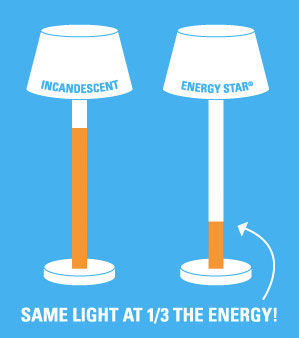
  • They use one-quarter the energy of traditional lighting fixtures
  • They must distribute light more efficiently and evenly that other standard fixtures
  • They support bulbs that must last at least 10,000 hours. (Typical light bulbs like incandescents last 1,000 hours)
  • They carry two-year warranty which is double the industry standard

Thursday, July 11, 2013

Aspects of a Full Home Energy Audit

Many homeowners are looking for ways to make their home more energy efficient and save money on their utility bills. Often times the energy company that performs a free home energy audit only checks obvious areas like lighting and air sealing.
It is important that your home energy auditor performs a complete home energy audit. Vital aspects of your home that should be checked in a home energy audit include:


*Heating and cooling system: Learning about the energy efficiency of your heating and cooling system is essential. If this is not checked there could be an abundant amount of energy being lost that you do not even recognize. Heating and cooling accounts for a large amount of energy use in your home and can be a major source of energy loss as well. Getting a complete home energy audit that assesses your heating and cooling system is something that you don't want to go without.
* Sealing: Although air sealing throughout your home is an obvious check, make sure it fully evaluates the air sealing. Simply checking around windows is not enough for your energy audit. A proper one should check for air leakage in your attic, foundation, and around any vents that may be letting in unwanted air.
When places are found throughout your home that are not sealed properly, it should suggest fixes such as insulation in the attic or basement, caulk and weatherstripping around doors and windows, and foam gaskets behind outlet and switch plates on walls. These fixes will keep in the conditioned air so that you are not wasting energy heating or cooling the outside, unconditioned air.
* Insulation: They are only complete when the insulation in your home is fully assessed. Many homeowners believe they have enough insulation in their home when this may actually be a major cause of energy loss. Simply checking to see if there is enough insulation is not a complete energy audit either though. Assessing your insulation r-value is essential.

Read more here

Wednesday, July 10, 2013

How to Measure the R-value of Attic Insulation [VIDEO]

Here is a video from REenergizeCO in Denver, Colorado.  They talk about measuring R-value in insulation and the correct amount needed in an attic of a residential home.  Nearly 50% of homes in the US do not have an adequate amount of insulation in their attic and suffer with higher utility bills.  This video shows you how to detect if your home has enough attic insulation.
 

Tuesday, July 9, 2013

7 Steps to Energy Savings

If you are afraid to open your gas or electric bill each month, reducing your home's energy use should be a priority of yours. Energy efficiency and pleasant indoor environment work hand in hand.  In this article you will learn how to evaluate your home's energy performance, determine where the biggest savings lie and maintain a healthy indoor environment.  You can find your home more comfortable and reduce your utility bills by following these 7 simple steps:
  1. Hire an Energy Auditor
    When it comes to saving energy, it is worth hiring a pro to evaluate your home and help you sort out the many possible energy-savings strategies.  If you are not sure how to find an energy audit company in your area, contact the local utility company to find energy auditors. It may supply this service for free or recommend an auditor.
    An energy audit typically costs between $250-450 and can be subsidized through a tax credit or community program.  The energy auditor will inspect your home and rate its current performance in terms of insulation levels, air leakage, condition of heating and air conditioning equipment and some other criteria.  The auditor can then tell you which upgrades are cost effective and estimate your energy savings. Cost-effectiveness is the absolute key! You can spend thousands of dollars for upgrades that won't save you much and a good auditor will steer you away from those. For an improvement to be worthwhile, the estimate savings should cover the cost of the improvement in about seven years.  An example being adding $200 in attic insulation will be worth it if you can save $30 a year ($210 after seven years).  Make sure the audit includes estimated savings for any improvements.
  2. Reduce Air Leakage
    Think of the warm air leaking out through gaps, cracks and holes in your home's walls and ceilings as your energy dollars floating away.  Sealing these openings is one of the greatest ways to save energy and is actually the most cost effective too.  Stopping air leaks in your attic is usually enough. You don't have to work your way through every room caulking every crack inside and out - you just need to cover the largest.
  3. Conserve Energy
    There are hundreds of energy savings steps that cost little to no money. Some ideas involve small investment of time and money like a programmable thermostat or caulking around windows, lowering the temperature on your water heater and closing your curtains.

Tuesday, June 25, 2013

20 Tips to Save Energy Around the Home

The best part about this list is all of these tips are FREE!  They won't cost you a dime and actually help you save energy and lower your utility bills for your home.
  1. Close the fireplace damper when you are not using your fireplace.  If it is never used, seal the flue with a plastic bag stuffed with insulation.
  2. Lower the indoor temperature a few degrees in the winter months.  You can add an extra blanket on your bed and lower it even more at night, up to 10 degrees when you're on vacation.
  3. Close off unused rooms and lower the temperatures by adjusting your registers and dampers. This can save you up to $50 a year alone.
  4. Open your shades or blinds to let in sunlight during the day and close them at night to reduce heat loss. For cooling, close them fully during the day in summer months.
  5. Clean your furnace's blower fan with a soft brush and vacuum cleaner.
  6. Ventilate and cool your home with window or whole house fans during the cooler hours of the day.
  7. Skip the dishwasher's drying cycle to cut energy use in half!
  8. Wash clothes in cold water rather than warm.
  9. Make sure to full fill washing machines and dishwashers for more efficiency use instead of partially full loads.
  10. Turn off lights that are not in use. Reduce bulb wattage and use dimmer switches.
  11. Clean you washer and dryer filters after each use.
  12. Flush your garbage disposer with cold water rather than hot. Grease solidifies in cold water and will wash away.
  13. Clean your refrigerator coils with a soft brush each spring.
  14. Run major appliances late in the evening or early morning to keep temperatures down in summer months and avoid heavy electric loads.
  15. Cook more efficientyly using microwaves, crockpots and pressure cookers.
  16. Ride your bike for neighborhood errands instead of your car.
  17. Turn off room air conditioners when you leave for an hour or more.  A room can quickly cool down when you turn your AC unit back on.
  18. Reduce humidity in bathrooms and kitchens wih exhaust fans. When dehumidifying your basement, close doors and windows.
  19. Lower your water heater setting to 120 degrees for energy savings.
  20. In warmer weather, set the thermostat higher, 74-76 degrees, and rely on your ceiling fans for cooling even when your air conditioning system is on.
Here are some helpful videos about home insulation.  Another great way to save money on your energy bills:
  1. Attic Insulation
  2. Crawl Space Insulation
  3. Home Energy Audit